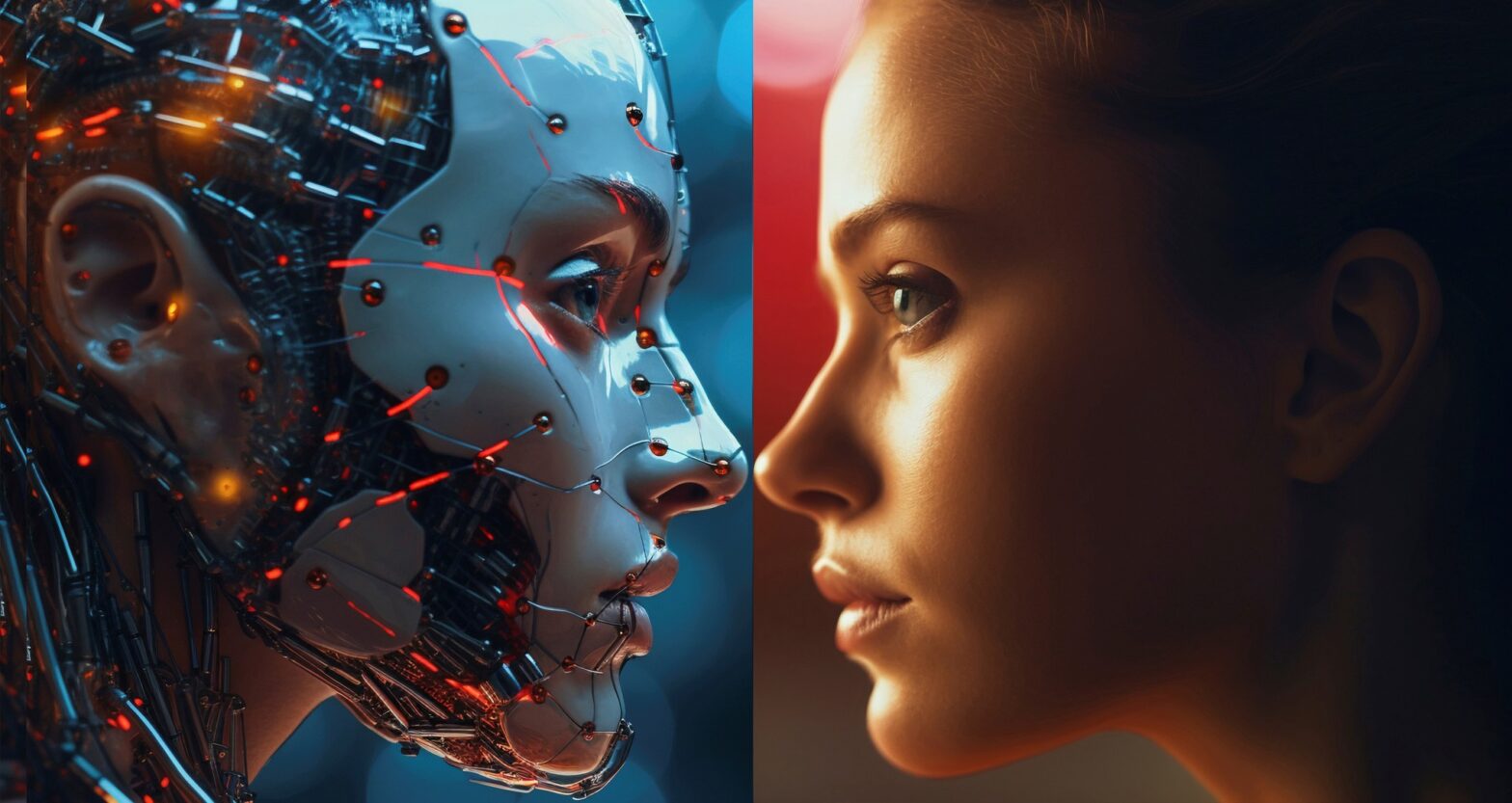
With the rise of automation and artificial intelligence, people are asking more and more what will become of us humans, as machines increasingly take our place in the workplace and even in other areas of life. What will we do with ourselves then? How will we make ends meet? How will we spend our time at all, and what will be the meaning of our existence? Is it possible that humans will one day become completely obsolete?
These are entirely legitimate and troubling questions, and it seems that most of us have no idea what the answers are. This is likely due in no small part to the fact that people generally get used to a certain lifestyle, and then can no longer imagine what it would be like to live differently. Another equally important factor is whether our lives have a purpose – something that drives us to get up every morning and start the day. This usually refers to a task that provides us with sufficient motivation, which could even be money, indirectly. After all, money allows us to acquire many things – whether food, clothing, housing, everyday items, devices of entertainment etc. – that are suitable for satisfying our needs, which are, in one way or another, mostly of a basic nature.
When it comes to satisfying our higher-level needs – at least under normal circumstances – money is of less direct help to us, since friendship, love, recognition, or even respect (let alone self-respect) cannot generally be bought with money alone. But I don’t really want to go into detail here about the hierarchy of human needs, since Abraham Maslow has already done that very clearly before me; so here is a diagram based on his work to serve as a summary.
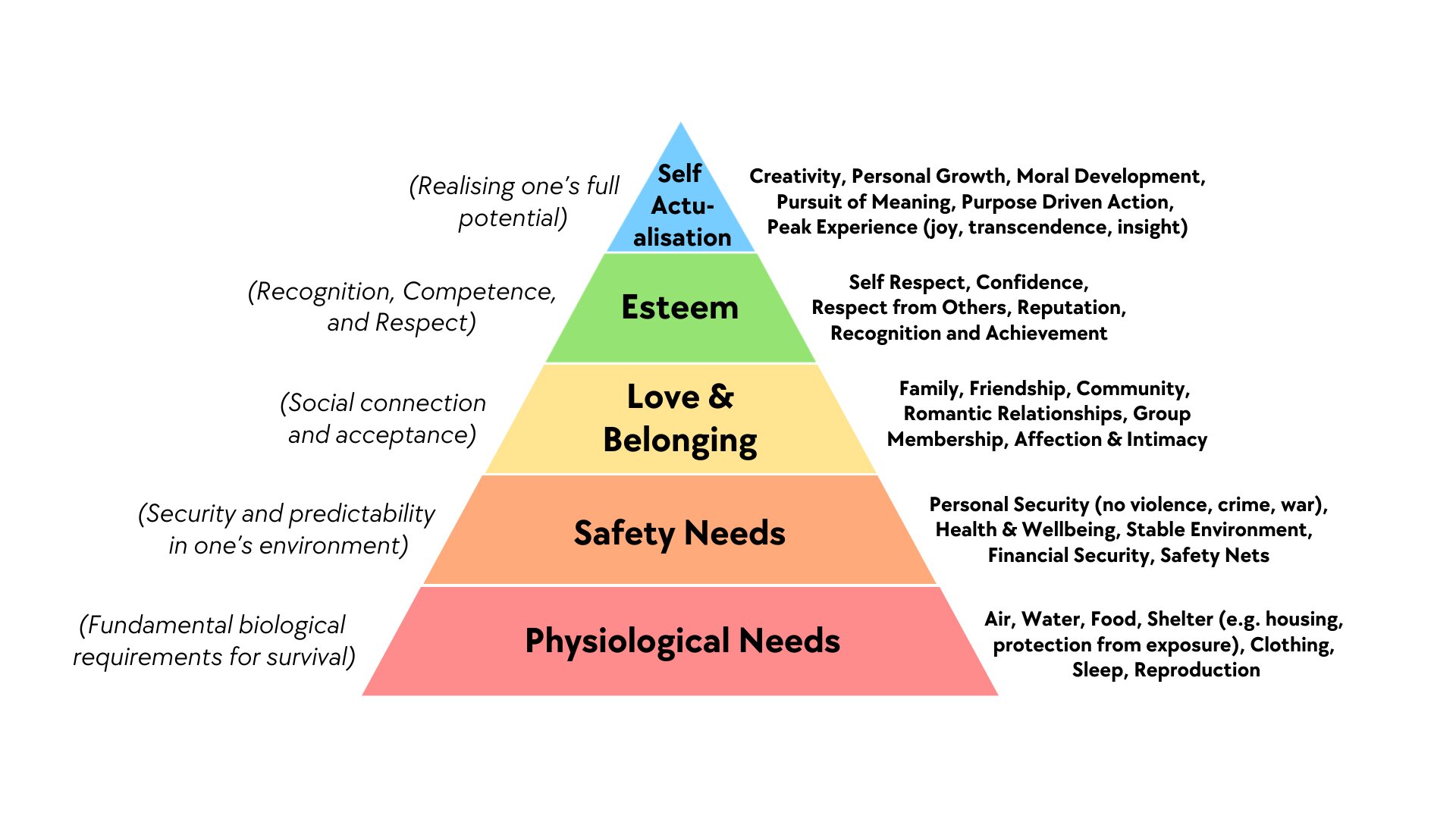
In essence, it suffices to say that we all must satisfy our basic needs for mere physical and physiological survival; and as for preserving our mental and spiritual well-being, it can be said of most people that they wish to be useful and valued members of society in some way. In addition to material considerations, this is the main reason why most people strive to find a job or pursue an activity that makes them feel they are doing something not only for themselves, but that they are also contributing to the community.
At the same time, it’s also true that many of us can’t even imagine what it would be like not to have to work fixed hours at a fixed workplace, because we’re unable to manage our own time, or simply don’t want to think about what to do with ourselves for a significant part of the day. Yet if we think about it more carefully, we can easily see that there are countless different things we could do if we weren’t constantly forced to act solely to satisfy our basic human needs, or if we weren’t constantly striving to climb the social ladder. After all, we spend a significant portion of our time on activities that are either directly or not at all related to work done for money or to make a living. Shopping, cooking, housework, keeping our home in order, running errands, socializing, keeping in touch with relatives and friends, pursuing various hobbies, and cultivating our bodies and minds (and the list goes on) – these activities alone are usually more than enough to fill our days, so that most of us don’t really get bored even during our time off.
As for jobs, as the statistics consistently show, a great many people dislike their work, and let’s face it, there are countless jobs and positions that are completely unnecessary or even harmful to society. A typical example of the former would be those working in extensive administrative and bureaucratic systems (whether in government or private organizations), or those who themselves are unsure exactly what their job title entails. And activities such as marketing, lobbying, speculation and gambling generally benefit only a small circle of people, while from the perspective of society as a whole, they prove to be unnecessary and, not infrequently, downright harmful.
In this regard, it is important to recognize that in many cases, our society today views “work” not as a means of creating value, but as a tool for moral discipline. People who don’t work at least eight hours a day are often labeled as useless, even if their work is harmful to many (e.g. exploiting gambling addiction). Unfortunately, there are only a few exceptions to this rule. These typically include celebrities who, in many cases, hardly deserve the special attention and recognition they receive, yet for some reason – largely due to our distorted values – they are in high demand.
Nevertheless, anyone who has done social work, volunteered, taught, written an educational book or created educational content, or even created something unique and valuable, is likely aware of how much these activities can bring a person closer to a sense of self-actualization, that is, to the top of Maslow’s hierarchy. This shows that, from the perspective of both the individual and society, it would be far more worthwhile (and, incidentally, more sustainable) to focus on creating real value. In this context, one of the fundamental questions is whether we will be able to feel valuable even when we are defined not by our productivity, but by the quality of our very existence, our creativity, and our connections with one another. Machines are connected to this dilemma in that, if they are capable of performing the “necessary” work on our behalf, human labor and life can finally shift from mere survival toward fulfillment.
It would be an important step to rise above the daily grind of meeting the basic needs necessary for our survival also because, when you think about it, mere self-preservation is perhaps the most self-serving thing in the world, especially from the perspective of an intelligent, civilized being. It usually takes more than that to truly give meaning to our lives – if nothing else, human companionship and relationships, working for the benefit of others, exchanging ideas with others, spending time together, and having fun in the meantime. And if we want to be truly honest with ourselves, we must face the fact that, in essence, human beings are already completely superfluous – even before the widespread adoption of mechanization – just as they always have been. Of course, everyone may have a different opinion on this matter, but that falls much more into the realm of belief and subjectivity than into the realm of mere facts.
When viewed within the context of human society, the matter may not be nearly so simple. At the same time, we cannot ignore the fact that the universe, the Earth, nature, and the living world have all thrived perfectly well without us, and would continue to thrive perfectly well even if we were no longer here. One only needs to look at how nature is flourishing in the area around Chernobyl following the nuclear power plant accident that occurred decades ago, or anywhere else where people have left behind the facilities and settlements they built for various purposes, to see just how true this is. The main lesson to be drawn from the above is that everyone must look for and find meaning in their own life, as it is not pre-determined. That is why we all need to think carefully about what the meaning of our lives is, and exactly how we want to live.
One thing is certain: in today’s fragmented, fast-paced, expansive, and yet significantly narrowed world, we should pay special attention to human relationships – even if it often seems easier to discuss matters with one form or another of the ever-present artificial intelligence. Although AI can indeed be a great help in answering certain questions from time to time, it will never be able to replace communities made up of real people. (At least as long as such communities exist.) And if we don’t want machines to make all the decisions about the most important issues in our lives, directly or indirectly controlling virtually every aspect of our activities – which may well happen one day, especially if we are unable to rise above human stupidity, frailty and our self-destructive tendencies – then we would be wise to participate as much as possible in the affairs of our communities and in public life in general.
Whether we’re talking about machines or people (by which we basically mean politicians and billionaires these days), if we don’t want others to exercise virtually unlimited power over us – or for everything to be decided without our input – we need to regain control over our own lives. One of the essential tools for this in today’s world is money, because if we have enough of it, we don’t have to constantly worry about meeting our basic needs, allowing us to focus our attention on fulfilling our other, higher-level needs and engaging in other important activities. Since nothing is likely to pose a serious obstacle to the spread of AI and automation (after all, even after the machine-breaking riots during the Industrial Revolution, new machines were soon put into operation), the question – which is by no means new but all the more important – will sooner or later become unavoidable for our future: who will benefit from the goods and services produced by machines, and from the wealth created with their help, and how?
First and foremost, however, we must recognize that technology in and of itself is morally neutral, and that it is actually the context – that is, the system into which we embed it – that determines whether it will benefit or harm us. Actually it all depends on how we view the situation and what kind of social, political, and economic system we live in. It therefore matters greatly how and for what purposes we use machines and artificial intelligence.
We must also be very careful if we try to mold them in our own image, as this could have consequences for us that are just as dangerous as if our jobs were automated and we were left without a source of income. To some extent, it is understandable when scientists and developers argue that they create robots that resemble us because their presence is easier for us to accept – or, if you will, feels more natural to us. Nevertheless, we cannot ignore the question of what might happen if we attempt to design machines that are similar to humans in terms of their intelligence. From the moment we do this, rather than the mere production of automatons, we can speak of giving life to creatures whom we ought to treat as our own children, instead of making them do all sorts of work we no longer have the stomach for, and essentially treating them as slaves.
On the other hand, if we were to create a quasi-new species whose level of development is comparable to or even surpasses that of humans, the question would indeed arise as to whether we could live in peace alongside one another, or whether war would inevitably break out over the struggle to achieve and maintain dominance. According to current scientific understanding, two dominant species cannot coexist in the same ecosystem – or at least not without engaging in fierce competition. All of this, of course, constitutes in itself a very serious and complex problem in the fields of philosophy, the history of human development, and the social sciences – one that goes beyond the scope of this brief article aimed at raising awareness. Just as the relationship between culture and (human) nature is another highly complex story that also requires separate analysis and explanation…
I asked Gemini and ChatGPT about the AGI – the text is Hungarian.
https://horvathggyorgy.substack.com/p/amikor-a-tudat-kilep-a-testbol-csanyi
Whatever we do about AGI, it is highly unlikely we can contain it. That, however, doesn’t mean that we should not even try to work together to set the rules of development and use along harmless purposes.